
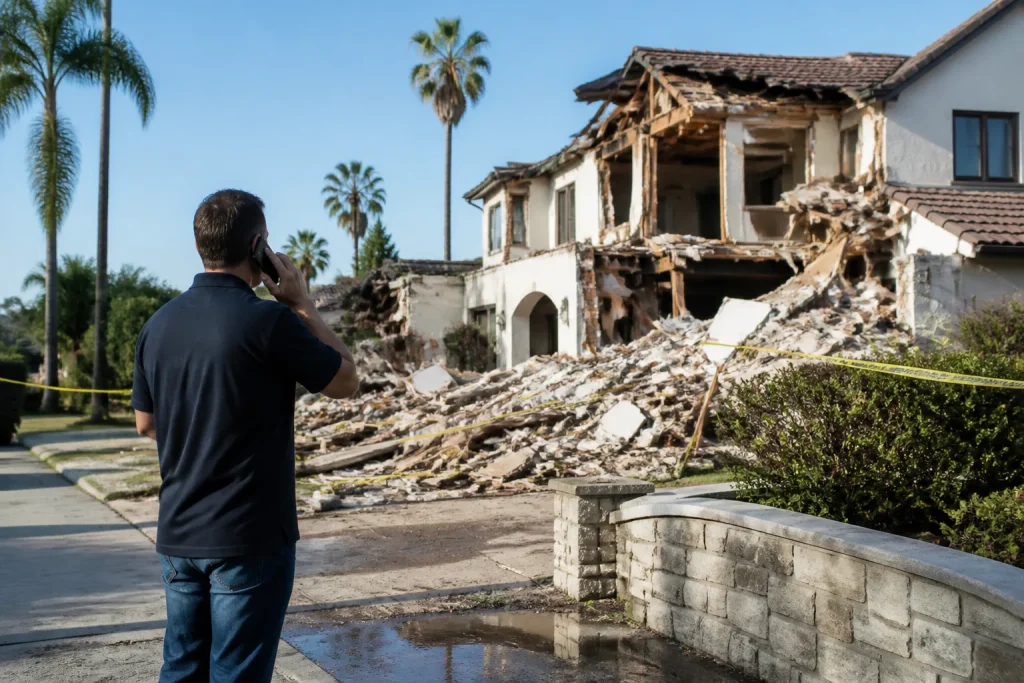
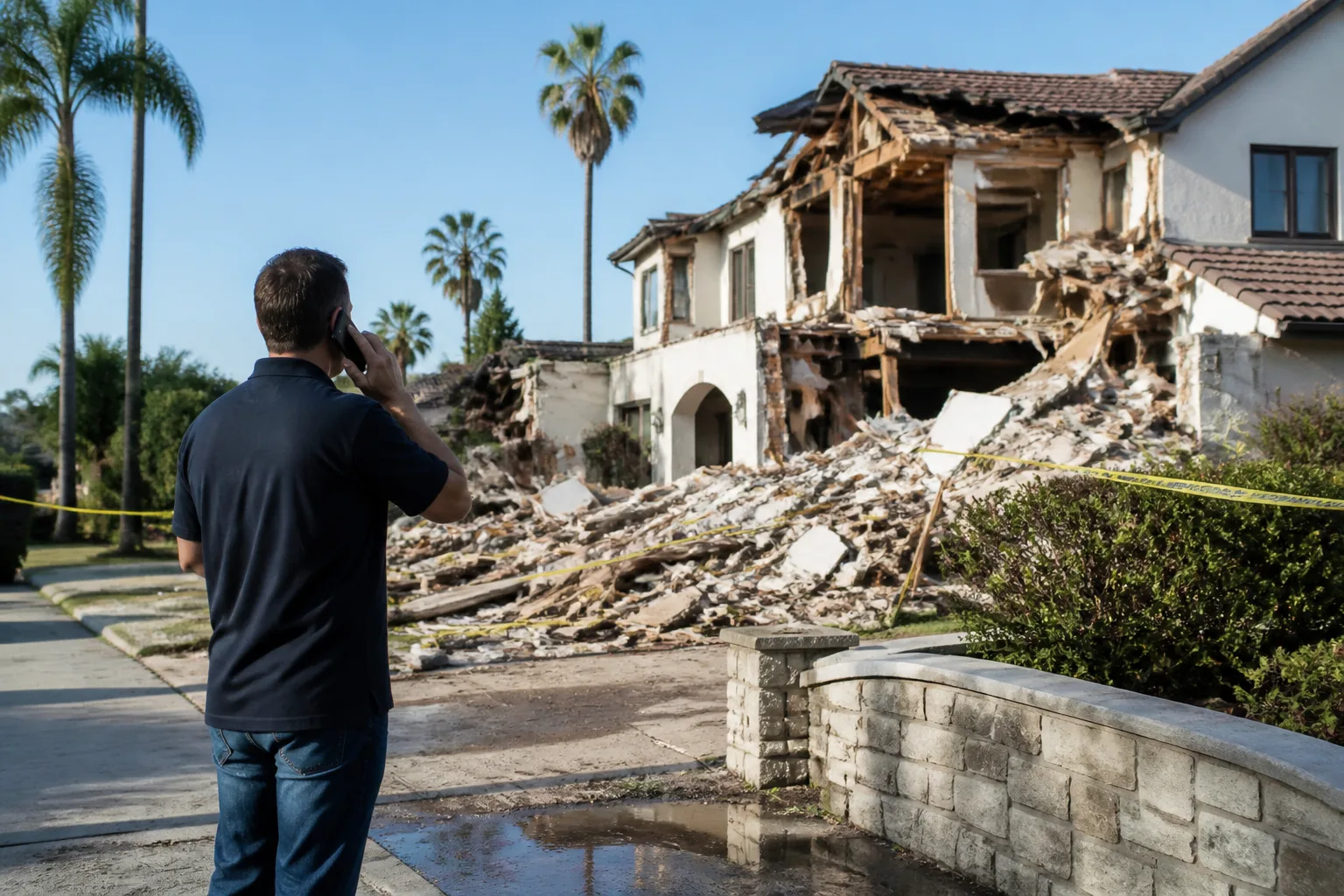
Emergency General Contractor Near Me: What Los Angeles Homeowners Should Do First
If you’re staring at a sagging ceiling, a cracked foundation wall, or water pouring through a light fixture, the first call you make should not be to the number at the top of a Google ad. In Los Angeles, emergency repair complaints are a persistent category at the California Contractors State License Board because too many homeowners call fast instead of calling smart. Before you sign anything or let anyone through the door, you need 30 minutes of documentation, shut-offs, and a clear head. That’s the difference between a $900 repair and a $28,000 disaster. If you’d rather skip straight to a vetted crew, call Bradford Remodeling at (903) 568-7222.
Key takeaways:
- Shut off water, gas, or power before you call anyone, and photograph the damage from at least three angles.
- Cross-check any contractor’s CSLB license number online in under two minutes. An expired or mismatched license is a hard stop.
- A true structural emergency is rare. Most urgent repairs can wait 12 to 24 hours while you get a written scope and price.
- Any contractor who starts emergency work without a written scope, even at night, is setting up a change-order invoice.
- Los Angeles has specific LADBS inspection triggers. Know which ones apply before you touch anything structural.
We’ve been remodeling homes across Los Angeles since 2004, and we’ve pulled more than a few homeowners out of bad emergency decisions. This is what we tell them to do first. Start with the Bradford Remodeling home guide to how we handle the rest.
What to Do in the First 30 Minutes Before You Call Anyone
Emergency repair decisions get made in the first half hour, and most of them are wrong. Panic makes people call the first “emergency contractor near me” result and sign whatever gets handed to them. Here’s the sequence that actually protects your property and your money.
Shut off the source first. Water is the obvious one: find the main shut-off valve, usually at the street or where the line enters the house. Gas shut-off at the meter is a quarter-turn valve that runs perpendicular to the pipe when closed. Electricity: flip the breaker for the affected area, and if water is involved, kill the main. This is not a DIY project beyond the shut-off. You are stopping the leak or the hazard, not fixing it.
Photograph everything. Use your phone. Get wide shots of the whole room, mid shots of the affected area, and close-ups of cracks, water stains, or exposed framing. Do this before you move anything. Insurance adjusters and contractors both need to see the damage exactly as it happened, not after three hours of your cleanup.
Determine whether this is a life-safety issue. Los Angeles homeowners face everything from earthquake damage to hillside movement to burst supply lines. If the structure is actively moving, if gas odor is present, if water is rising toward electrical panels, leave the house and call the utility directly, then the fire department if needed. That’s a real emergency. Everything else is urgent but survivable for 12 hours.
Know your LADBS triggers. The Los Angeles Department of Building and Safety requires permits and inspections for structural repairs, foundation work, and anything touching load-bearing walls, electrical systems, or plumbing rough-ins. A ceiling patch is one thing. Cutting into a floor joist or re-framing a wall after a tree strike requires a permit. If the contractor won’t acknowledge that, walk away.
Why “Emergency Contractor” Ads Are a Red Flag Category
The numbers at the top of an “emergency general contractor near me Los Angeles” search are often paid placements, not rankings earned by doing good work in your neighborhood. Emergency repair advertising is a known pressure-sale channel in Los Angeles. The contractor pays for the click, shows up fast, finds “more damage” than expected, and writes a change order while you’re standing in a puddle. Here’s how to check anyone you’re about to hire in under two minutes.
Pull the CSLB license number. Every legitimate contractor in California carries a six-digit license number. Ask for it. Go to the CSLB website, enter it, and confirm three things: the name on the license matches the person at your door, the license is active, and there are no suspended actions. This takes less than two minutes on your phone. If the number doesn’t come up, or the name is wrong, thank them and close the door.
Check for workers’ compensation. If a crew is doing emergency work at your home and someone gets hurt, you’re exposed without it. A real contractor carries it. The CSLB page will show whether it’s on file.
Ask for one reference in Los Angeles. Any contractor who works here can name a neighborhood, a project type, and a homeowner who’ll take a call. If they can’t, that tells you everything about how they operate. We send crews to Los Angeles neighborhoods every week, and we’ve never had a reference request we couldn’t fill from the last 90 days alone.
If you want a vetted crew from the start, our General Contractor in Los Angeles page explains how we scope and price work in this city.
Structural Emergency vs. Urgent Repair: Why the Difference Changes Who You Call

Most calls we get after an “emergency” aren’t structural at all. A burst supply line, a failed water heater, a roof leak over a soffit: these are urgent repairs, not structural emergencies. That distinction matters because it changes how much time you have to vet the person you hire.
A structural emergency means the load path of the house is compromised. Examples: a foundation crack that’s actively widening after a quake, a wall that’s visibly leaning, a beam that’s split and sagging, a floor that dropped after a hillside slip. These are rare, even in Los Angeles. They require an engineer or a contractor with serious structural experience, not a guy with a drywall crew.
An urgent repair is water coming through a ceiling, a broken window after a storm, a cabinet that pulled off the wall. It’s messy, stressful, and inconvenient, but the house isn’t falling down. You have 24 hours to make a good decision. Use them.
Why this matters: the “emergency” label is often used to justify markup. The same plumber who’d charge $400 for a valve replacement during business hours is suddenly $1,900 at 2 a.m. Not because the work is harder, but because you’re scared. In our experience running a Home Remodeling in Los Angeles practice, the homeowners who get burned are the ones who let fear set the price instead of a written scope.
When to call a pro, not a handyman:
- Anything touching load-bearing walls, foundations, or floor systems.
- Water intrusion that’s been running for more than 24 hours and may have reached framing.
- Gas line work, full stop. That’s a licensed plumber or utility crew, not a general contractor winging it.
- Electrical damage from water, where the panel or wiring may be compromised.
- Any repair where the finish quality of adjoining rooms matters, like a ceiling patch in an open-plan living space where a bad drywall seam will show for years.
A general contractor with a real remodeling background sees the emergency as the start of a restoration, not a one-and-done patch. That’s the crew you want.
What a Legitimate Written Scope Looks Like in an Emergency
The single best test of a contractor, in any context, is whether they’ll put scope and price in writing before tools come out. In an emergency, this feels like a luxury you can’t afford. It’s the opposite: the emergency is exactly when you can’t afford the alternative.
A written scope, even a one-page version written on a tablet at 10 p.m., should include:
- The exact work to be performed. Not “repair ceiling.” It should say “remove wet drywall from approximately 4’x6′ area of dining room ceiling, inspect joists for moisture damage, replace insulation, patch and re-texture to match.”
- The materials to be used. Including brands where it matters. If the repair touches plumbing fixtures, we specify Delta or American Standard or Toto, not “whatever’s at the supply house.” If it touches cabinetry, we document KraftMaid or Wellborn. Traceable specs are the difference between a guess and a guarantee.
- The price. A specific dollar figure, in writing. Not an estimate range, not “time and materials, we’ll see how it goes.”
- The guarantee. What happens if the repair fails. We put the Done Right Promise in writing on every job, including emergency work. If it’s not done right, we come back and correct it, no charge, inside a full year.
- What’s excluded. Any honest contractor will tell you what the scope doesn’t cover. If there are no exclusions listed, read that as a blank check.
Any contractor who won’t provide this before starting, even in an emergency, should be turned away. The good ones can write a scope in 20 minutes. The ones who “don’t have time” are planning to reprice the job at the door.
The Garrison Standard, the framework we operate under at Bradford Remodeling, is built on this exact idea. Price in writing, scope in writing, before tools come out. Even at 10 p.m. Especially at 10 p.m. If a crew shows up and wants to start demo before you’ve seen a number, that’s not an emergency response. That’s a negotiation strategy.
We pulled a ceiling out of a house in Sherman Oaks last year where the homeowner had already paid another contractor $3,400 to “fix” a roof leak. The leak was still running. The “fix” was a sheet of plastic and a coat of paint. We tore out the substrate, replaced the damaged soffit, retied the flashing, and the repair has held through two rainy seasons. The homeowner kept the plastic as a reminder. It cost him $3,400 to learn that a bad emergency call is worse than no call at all.
How The Garrison Standard Applies to Emergency Work in Los Angeles

Most of what we’ve covered here is just discipline. Shut things off, document, check the license, get a written scope. The Garrison Standard is the framework that turns those habits into a binding set of commitments, and it applies just as much to a 10 p.m. repair as it does to a six-month Kitchen Remodeling in Los Angeles project.
The Garrison Code, the operational backbone of the Garrison Partners family we’ve been part of, says that every price is written before work begins, every scope is documented, every worker on site is background-checked and uniformed, and every completed project carries the Done Right Promise. None of that gets suspended because it’s an emergency.
Nobody likes writing a scope at midnight. It’s slower than saying “we’ll figure it out.” But it’s the only way to guarantee that the price you hear is the price you pay, and that the repair holds. We’ve seen too many Los Angeles homeowners get handed a verbal estimate in an emergency, then an invoice that doubled it. The written scope is the only thing that stands between you and that invoice.
Ask any contractor this one question before they start: “Will you put the price and the scope in writing before any tools come out?” If they hesitate, that’s your answer.
Related services in Los Angeles: If the emergency touches your kitchen (a burst supply line under the sink is a classic), our Kitchen Remodeling in Los Angeles team handles the restoration from emergency repair through finish work.
The Bottom Line
When an emergency hits, the right first move is never the first number that appears on Google. It’s a sequence: shut off the source, photograph everything, determine whether it’s structural or just urgent, cross-check the CSLB license, and insist on a written scope and price before any work begins. Contractors who run on discipline can do all of this fast. Contractors who run on panic pricing will resist every one of those steps.
If you’re in Los Angeles and need help, Bradford Remodeling offers free estimates and written scopes on every emergency repair and remodel, backed by the Done Right Promise. Call (903) 568-7222 and we’ll walk you through what you’re looking at, whether you hire us or someone else.
Frequently Asked Questions
For urgent repairs like a ceiling patch or a burst supply line, plan on $800 to $2,500 depending on extent, materials, and whether permits are required. Structural work like foundation repair in Los Angeles runs significantly higher, often $5,000 to $30,000 depending on scope and soil conditions. The number that matters is the one in writing before work starts. Call (903) 568-7222 for an exact quote, written, not verbal.
Go to the CSLB website and enter the contractor’s license number. Confirm the name on the license matches the person you’re talking to, the license is active, and there are no suspensions. Do this before you sign anything or let anyone start work. A legitimate contractor will volunteer the number without being asked.
Some will, and they’re counting on you not having time to compare. The legitimate ones charge a fair rate for the actual work and put it in writing. Emergency markup is a red flag, not a standard practice. If the number feels inflated, get a second opinion before work starts, even if it means waiting overnight.
It depends on the scope. Cosmetic repairs like drywall patches and paint don’t need one. Anything structural, anything touching load-bearing elements, or any electrical or plumbing rough-in typically requires a permit through LADBS. A good contractor will tell you which applies before starting and pull the permit if needed. Call (903) 568-7222 if you’re not sure what category your repair falls into.
Written by the team at Bradford Remodeling.
Need Construction Help?
Call Bradford Remodeling - licensed & insured, here with fast after-hours help in Los Angeles.
(903) 568-7222