Last updated October 9, 2026








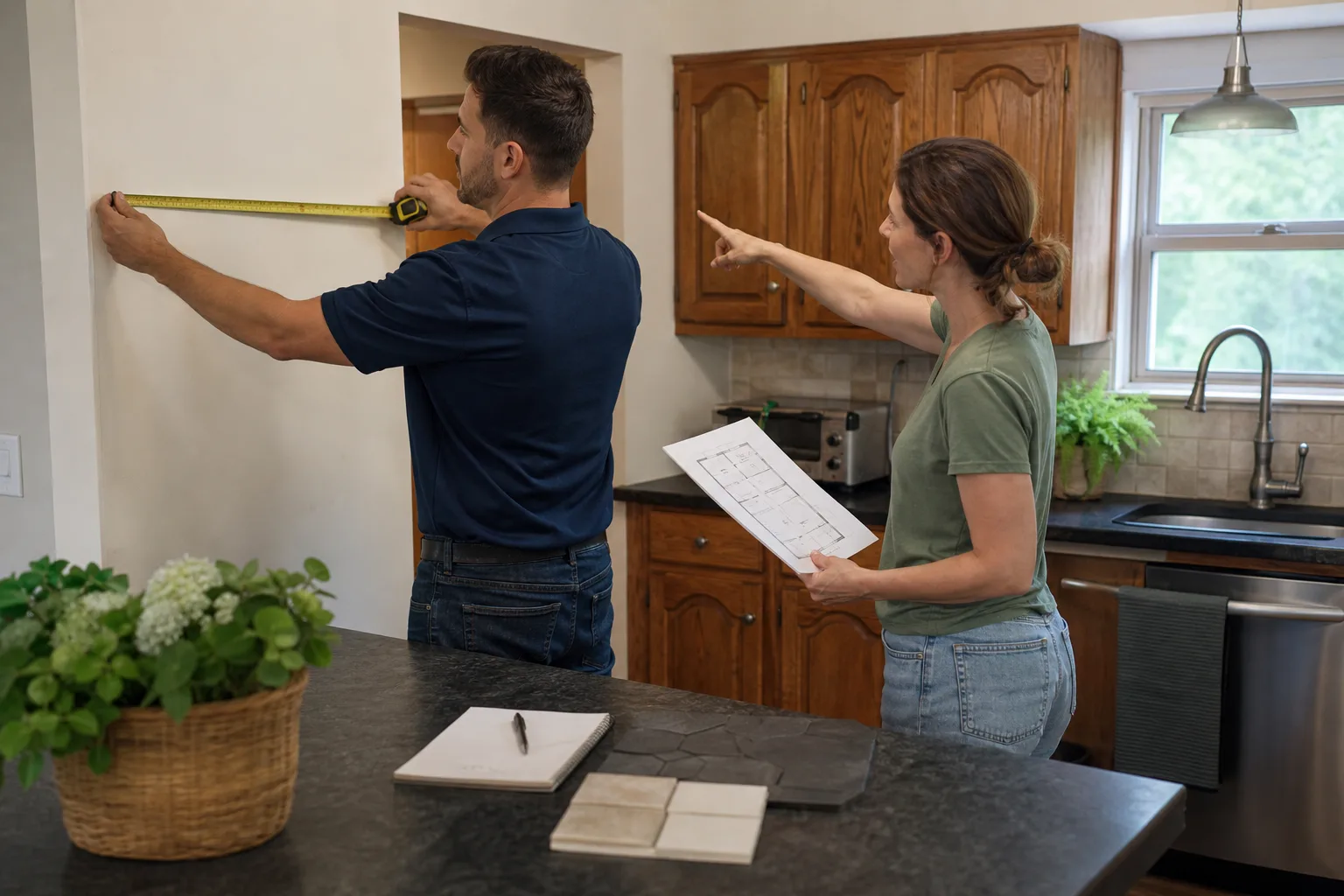
Free written scope consultation - allowances, timeline, and change-order rules on paper before a single trade is scheduled
Construction Warning Signs: A Los Angeles Homeowner’s Reference Guide
The most expensive warning sign Los Angeles homeowners miss isn’t the contractor who asks for 50% upfront. It’s the one who gives you a detailed verbal scope and a one-page contract. A contractor who won’t write it down doesn’t want to be held to it. This guide catalogs the specific red flags we’ve seen across two decades of remodeling work in Los Angeles, from Studio City bungalows to Pasadena craftsman homes. You’ll learn what to look for before you sign, during the job, and at final walkthrough.
Most construction warning signs aren’t dramatic. They’re the small, specific things a contractor says or doesn’t put in writing that signal you’re about to have a problem: a missing line item, a vague allowance, a subcontractor who won’t show his license. By the end of this guide, you’ll know the difference between a contractor who runs a disciplined operation and one who’s about to disappear with your deposit.
Quick Answer
The most reliable construction warning signs in Los Angeles fall into three categories: contract red flags (no lien waiver clause, no milestone-based payment schedule, no written change-order requirement), bid red flags (vague allowances, missing line items that every other bid includes), and conduct red flags (unlicensed subcontractors, permit delays, crew size reductions mid-job). A contractor who resists putting scope, price, and warranty terms in writing is signaling that you’ll have no leverage when the job goes sideways. In Los Angeles, where construction disputes routinely end in mechanics liens, the contract is the only thing protecting your property.
Styles & brands we work with







Table of Contents
- Contract Red Flags: What’s Missing That Signals Legal Exposure
- Bid Red Flags: How Low-Ball Pricing Is Structured to Win and Then Change
- Workmanship Red Flags You Can See Before Final Inspection
- Subcontractor Warning Signs and California Liability
- Project Management Signals That Reveal a Contractor’s Cash Position
- What a Disciplined Construction Operation Looks Like
- Common Mistakes to Avoid
- When to Call a Professional
Contract Red Flags: What’s Missing That Signals Legal Exposure
In California, a construction contract isn’t a formality. It’s the document that determines whether you can recover anything when a job stalls, a subcontractor files a mechanics lien, or the work doesn’t pass inspection. Los Angeles courts see thousands of residential construction disputes every year, and the homeowners who lose are almost always the ones whose contracts were thin.
Here’s what we tell homeowners to check before signing anything:
- No lien waiver clause. In California, a subcontractor or material supplier who isn’t paid can file a mechanics lien against your property, even if you already paid the general contractor in full. A contract that doesn’t require the GC to condition final payment on lien waivers from every sub and supplier leaves you exposed. You can pay the full contract price and still get a lien filed on your Culver City house.
- No payment schedule tied to milestones. A contract that says “50% down, 50% on completion” sounds simple but gives the contractor no incentive to hit intermediate deadlines. The payment schedule should be tied to specific, inspectable milestones: rough-in inspection passed, drywall hung, cabinetry installed. In Los Angeles, where a whole-home remodel can run six to nine months, milestone payments keep money moving with progress instead of promises.
- No written change-order requirement. This is the single biggest contract omission we see. Without a clause requiring every change to be written, signed, and priced before work proceeds, a homeowner who asks for different tile during a kitchen remodel in Los Angeles has no record of what was agreed to. The final invoice arrives with a number that matches nothing you remember agreeing to.
- Vague scope of work. “Remodel kitchen” is not a scope. “Demo existing cabinetry, relocate plumbing for island sink per plan dated [date], install KraftMaid cabinetry per approved layout, install Cambria quartz countertops in [color name]” is a scope. A contractor who won’t specify materials by brand and model is leaving room to substitute cheaper products at the same price.
- No contractor license number on the document. California requires every construction contract to include the contractor’s CSLB license number. If it’s missing, that’s not a clerical error. That’s a warning sign.
The Garrison Standard, the operating framework we follow at Bradford Remodeling, treats the contract as the project’s foundation. Every scope, every allowance, every payment trigger goes in writing before any tool leaves the truck. If a contractor tells you the details will be “worked out along the way,” that’s not flexibility. That’s the absence of a plan.
Bid Red Flags: How Low-Ball Pricing Is Structured to Win and Then Change
Los Angeles is one of the most expensive construction markets in the country, and homeowners here get bids that swing wildly. A spread of 15 to 20 percent between qualified contractors is normal. A spread of 40 percent is not. When one bid comes in dramatically lower than the other two, here’s what’s usually happening underneath the number.
Vague allowances
An allowance is a placeholder dollar amount for a material the homeowner hasn’t picked yet, like tile, flooring, or plumbing fixtures. A disciplined contractor sets realistic allowances based on the actual market: $8 per square foot for tile, $450 per fixture for mid-range faucets. A low-ball bid sets allowances at half the real cost. You sign at $40,000, then discover the allowance for your Los Angeles kitchen’s cabinetry is $6,000 when comparable cabinets run $18,000. The contractor makes margin on the overage.
Missing line items every other bid includes
Compare bids line by line. Does one bid include a line for permit fees? For dumpster rental and debris hauling? For demolition? For site protection? For the scaffolding required on your Silver Lake hillside lot? A contractor who “forgot” a line item that every other bidder included is building in a change order before the job starts.
The number that’s too round
Real construction pricing is specific. It comes from measured square footage, known material costs, and labor hours calculated by trade. A bid that lands on an even $60,000 with no line-item breakdown hasn’t been bid at all. It’s been guessed. And the guess is designed to win your signature, not to build your project.
Every Bradford Remodeling bid includes a written price before any work starts, with line items you can verify against current Los Angeles material and labor costs. No numbers that move at the door. No allowances set at fiction to make the total look competitive.
Workmanship Red Flags You Can See Before Final Inspection
You don’t need to be a contractor to spot rushed work. You need to know what the trade’s standards look like when the job is done right, and what they look like when somebody cut corners. Here are the specific things we tell Los Angeles homeowners to check at their rough-in and pre-drywall walkthroughs.
Out-of-plumb framing tolerances
Framing that’s out of plumb means a wall that leans. The National Association of Home Builders tolerance standard is 1/8 inch per 8 feet for load-bearing walls. You can check this with a 4-foot level held vertically against the stud. If the bubble is outside the lines on studs that will carry weight, the framing is out of tolerance. In earthquake-prone Los Angeles, this isn’t cosmetic. Out-of-plumb framing throws off door and window installation, drywall joints, and load distribution.
Fastener pattern spacing on sheathing
Sheathing is the structural paneling nailed to the outside of the studs before stucco or siding goes on. Building code specifies fastener spacing, typically 6 inches on panel edges and 12 inches in the field for wall sheathing in seismic zones. Walk the perimeter of your Los Angeles home during the sheathing phase and look at the nail pattern. Gaps where nails are missing or spacing that drifts wide means the panel isn’t secured to code. This is the kind of defect that gets covered by stucco and never seen again, until a seismic event tests it.
Stucco scratch-coat texture
In Los Angeles, where stucco is the dominant exterior finish, a proper three-coat stucco system starts with a scratch coat that’s roughly 3/8 to 1/2 inch thick, scratched with horizontal lines to give the brown coat something to bond to. Rushed work shows up as a scratch coat that’s too thin, missing the scratch marks entirely, or shot over damp or dirty substrate. The scratch marks aren’t decorative. They’re mechanical bond. If the scratch coat looks like a smooth coat, the brown coat will delaminate.
These are the standards we hold our crews to on every Bradford Remodeling project: framing that’s toleranced to code, fastener patterns that match seismic requirements, substrate preparation that doesn’t get covered up and hoped for. A walked job site should show you the work, not hide it.
Subcontractor Warning Signs and California Liability
Here’s the reality of California construction law: if your general contractor hires an unlicensed subcontractor, the liability transfer isn’t small. Under California Business and Professions Code section 7031, an unlicensed contractor cannot collect payment for work requiring a license, and in some cases the homeowner can recover what they’ve paid. But the practical risk is heavier than the legal remedy.
Unlicensed subcontractors don’t carry workers’ compensation insurance. If an unlicensed worker is injured on your Los Angeles property, you’re the one who gets named in the lawsuit. The GC’s general liability policy won’t cover an unlicensed sub’s crew. The sub’s nonexistent policy won’t either. Your homeowner’s insurance may deny the claim because you contracted with an unlicensed party. This is not a rare scenario. It’s a standard pattern in California construction litigation.
What to check
- Ask your GC for the name and CSLB license number of every subcontractor before they start work.
- Verify each license on the CSLB website. It’s a two-minute process. Confirm the license is active, current, and matches the trade the sub is performing.
- Ask for proof of workers’ compensation insurance from the GC and every sub. In California, a GC who claims to have no employees must still carry coverage for any sub without their own policy.
- Watch for crews that change from week to week. A GC who uses a different tile crew on Tuesday than he used Monday is often pulling labor from a labor broker, and labor brokers don’t always verify licensing.
We maintain a documented roster of licensed, background-checked technicians at Bradford Remodeling. Every person who walks through your door is uniformed, identified, and held to The Garrison Code, the conduct standard set at the Garrison Partners level. You know who’s in your house before the crew arrives. That’s not a convenience. It’s a liability control.
Project Management Signals That Reveal a Contractor’s Cash Position
A contractor’s cash position is the thing homeowners never think to check, and it predicts project abandonment more reliably than any workmanship issue. Here’s what the signals look like on a Los Angeles job site.
Permit pull delays
Pulling permits in Los Angeles costs money, and the fees are due when the permit application is filed. A contractor who stalls on pulling permits for weeks after the contract is signed is often stalling because they can’t cover the fee. They may be using your deposit to finish another job first. In Los Angeles, where LADBS permit timelines can run weeks, a contractor who hasn’t filed within the first five business days is a warning sign.
Material delivery gaps
Materials get delivered when they’re paid for. A job site that sits empty for two weeks waiting on cabinets, windows, or drywall is usually not waiting on the supplier. It’s waiting on the contractor’s credit line. Suppliers put contractors on cash-only terms when they’re slow to pay, and cash-only contractors prioritize whichever job is funding that week.
Crew size reductions
A job that starts with six workers and drops to two by week three isn’t necessarily about scope. Contractors move crews to whichever job represents their biggest outstanding receivable or their most urgent profit need. If your Los Angeles remodel gets quieter halfway through, ask where the crew went. The honest answer may be legitimate. The evasive answer is the warning.
The Garrison Standard addresses this directly: written payment schedules tied to completed milestones, documented material orders with delivery dates, and a project plan that shows who’s on site and when. Our crews don’t disappear mid-job because our financial structure doesn’t depend on borrowing from the next project to finish this one.
What a Disciplined Construction Operation Looks Like
Most guides tell you what red flags look like. This section shows you what the absence of red flags looks like, so you can spot a disciplined contractor before you’re in the bidding process. We’ve spent twenty years building this standard at Bradford Remodeling, and it’s what we hold ourselves to on every job from a Sherman Oaks kitchen to a Los Feliz whole-home renovation.
The written price, always
A disciplined contractor hands you a written, line-item price before any work starts. Not a verbal estimate. Not a “ballpark” that gets refined later. A number you can hold them to. At Bradford Remodeling, this isn’t optional. It’s The Garrison Standard: a written price before work begins, no exceptions.
The warranty in your hand
Ask any contractor what happens if the work fails six months after completion. A disciplined operation has a specific answer with a specific term. Ours is the 365-Day Done Right Promise: every completed project carries a full-year written guarantee, and if the work fails inside that window, Bradford Remodeling returns and corrects it at no charge. You get that guarantee in writing at job close, not as a verbal assurance.
Traceable materials
When a contractor specifies “quality cabinetry” and can’t name a manufacturer, you’re buying a mystery. When they specify KraftMaid or Wellborn, you can look up the warranty, the construction specs, and the replacement parts. We install documented brands across our projects: KraftMaid and Wellborn cabinetry, Cambria and Caesarstone surfaces, Kohler and Moen fixtures, GAF and James Hardie exterior products, Therma-Tru doors, Belgard hardscaping. The specifications are traceable, which means quality isn’t left to guesswork.
A clean site at close
“Squared away” at job close means a site that’s swept, debris hauled, scope verified against the contract, and a signed written guarantee in your hand. That’s not the extra mile. That’s the disciplined baseline. If a contractor’s final walkthrough doesn’t include a documented scope review and a written warranty, the job isn’t actually done.
If you’re planning a project, start with our General Contractor in Los Angeles guide to understand what a qualified contractor should offer. For specific scopes, see our Kitchen Remodeling in Los Angeles and Home Remodeling in Los Angeles pages, or start at the Bradford Remodeling home page to review our full service range.
Common Mistakes to Avoid
- Signing a one-page contract. A one-page contract for a six-figure remodel is not streamlined. It’s indefensible. You’re giving someone access to your Los Angeles property and your money without a written scope, payment schedule, lien waiver requirement, or change-order process.
- Accepting “I’ll send the license later.” California contractor licenses are public record and verifiable in seconds on CSLB. A contractor who can’t produce a license number at the first meeting shouldn’t get a second one.
- Paying cash without a receipt. Cash payments with no paper trail are how homeowners end up unable to prove what they paid when a dispute hits. Every payment should be documented and tied to a milestone in the contract.
- Skipping the pre-drywall walkthrough. This is your only chance to see framing, electrical, plumbing, and HVAC rough-in before it’s covered. Los Angeles homeowners who skip this walkthrough lose their only visual verification of the infrastructure inside their walls.
- Hiring the lowest bid without line-item comparison. The lowest bid is the most expensive bid when structured around low allowances and missing line items. Compare bids line by line, and ask why a number is missing instead of assuming you’re saving money.
- Not verifying lien waivers at final payment. In Los Angeles, a mechanics lien can be filed months after you’ve moved back in. Condition your final payment on lien waivers from every subcontractor and supplier, and keep those waivers in a file.
When to Call a Professional
Call a professional before you sign a contract, not after a problem appears. A licensed Los Angeles general contractor can review an existing bid, walk a property you’re considering, or assess work already completed for code compliance and workmanship. If you’re in a dispute, a contractor with experience in California construction law can tell you whether you have a legitimate claim or a cosmetic complaint. If you’re planning a remodel and want the scope, price, and warranty in writing before work starts, Bradford Remodeling offers free estimates in Los Angeles. Call (903) 568-7222 to schedule yours. Curtis Lane and our team walk every project site before we price it, and the price you get is the price you’ll sign.
See the difference
 Before
 After
After Before
 After
After Before
 After
AfterFrequently Asked Questions

The most common red flag is the absence of a written change-order requirement. Without it, every verbal change you request becomes an unverified cost at the end of the job, and you’ll have no written record to dispute it. Call (903) 568-7222 if you want one of our estimators to review a contract you’ve been given.
Go to the CSLB website, enter the contractor’s license number, and confirm the license is active, the name matches the person you’re dealing with, and the classification covers the work being done. This takes under five minutes and is the single best check you can run before signing anything.
An unlicensed subcontractor generally cannot enforce a mechanics lien in California, but their unpaid suppliers can, and an unlicensed worker injured on your property can sue you directly. The practical risk is that you’re exposed to liability your own insurance may not cover.
California law caps the down payment at 10 percent of the contract price or $1,000, whichever is less. Any contractor asking for more than that before work starts is breaking state law. Beyond the legal cap, a disciplined payment plan ties subsequent payments to completed milestones.
A fair payment schedule ties money to inspectable milestones: permit pulled, rough-in passed, drywall complete, cabinetry installed, final inspection signed off. The schedule gives the contractor working capital without getting ahead of the work performed, and it gives you leverage at every stage.
Yes. Every Bradford Remodeling project requiring a permit files through the appropriate Los Angeles agency, and we don’t start covered work until the permit is issued. Permits protect you legally and structurally, and a contractor who suggests skipping them is asking you to accept legal and safety risk to save their time.
The Bottom Line
Construction warning signs in Los Angeles are almost always visible before the damage is done, if you know what to check. For more guides & resources on protecting your project, explore our blog. Read the contract for the clauses that should be there and aren’t. Compare bids line by line, not just by total. Walk the job site at rough-in and look at the work that’s about to be covered. Verify every subcontractor’s license. Watch for the project management signals that reveal how the contractor is financed. The homeowner who asks these questions before signing is the one who doesn’t end up in a dispute. The contractor who welcomes the questions is the one you can work with. At Bradford Remodeling, every price and every guarantee goes in writing before a single tool comes out. That’s The Garrison Standard, and it’s applied on every job we run in Los Angeles.
Written by Curtis Lane, Owner at Bradford Remodeling, serving Los Angeles since 2004.